How the Bessemer converter built the modern skyscraper
Before 1856, the tallest habitable building in America was seven storeys. By 1913, it was the Woolworth Building at 57 storeys. The difference wasn't the elevator — it was the fact that steel became cheap enough to build with.
Iron's ceiling
Cast iron carries load well in compression but shatters in tension. Wrought iron does the opposite. Neither can carry both, which caps how tall you can build without walls thick enough to swallow the ground floor. The Home Insurance Building in Chicago (1885, 10 storeys) was the first to try steel columns — and it worked because Bessemer's converter had, by then, cut steel prices by roughly 80%.
What the converter actually does
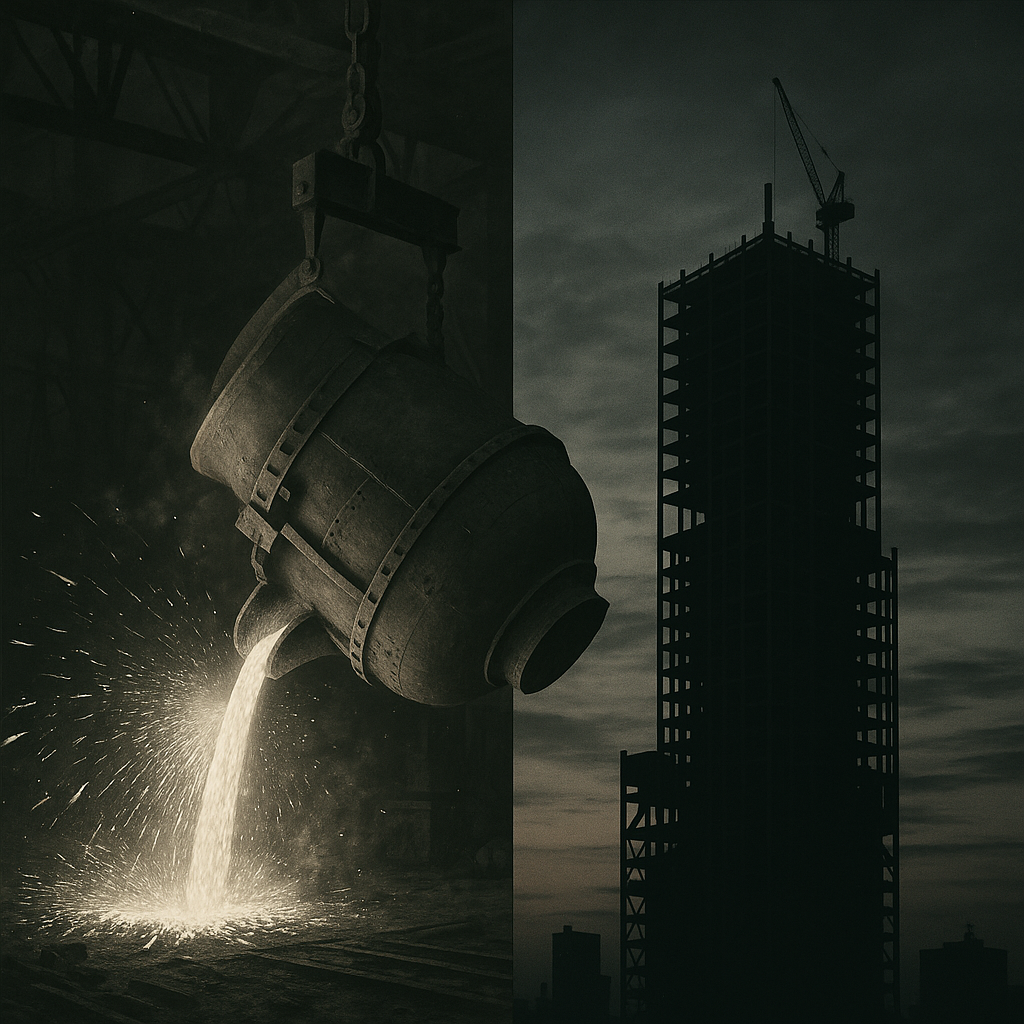
You pour molten pig iron — 4% carbon — into a tilted pear-shaped vessel. Air blasts through the bottom. Oxygen bonds with the carbon and blows out as CO₂, taking silicon and manganese with it. In fifteen minutes you have low-carbon steel that would have taken a puddling furnace a week to produce.
The urban cascade
- Steel columns replaced masonry piers → thinner walls → more usable floor area per floor
- Steel beams enabled 30-metre spans → larger open-plan rooms
- Riveted frames pre-fabricated off-site → construction schedules dropped by half
- Elevators became worth installing → the top floor became the most valuable
The successor
By the 1950s the Bessemer converter had given way to the basic-oxygen furnace (BOF) — same principle, pure oxygen instead of air, cleaner steel, better metallurgical control. Every skyscraper still riding on the skyline was born inside a BOF descendant of Bessemer's original vessel.
Bessemer didn't design a building. He designed the material that let architects design differently.